


The development of Radiology
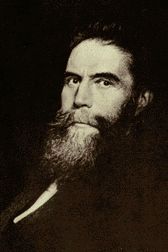
Just over a century ago, on 08/11/1895, German Wilhelm Conrad Röntgen discovered a previously unknown radiation that would later be named after him. Wilhelm Conrad Röntgen was born on March 27, 1845. In 1868 he received his degree in mechanical engineering and a year later in 1869 he earned a doctorate in physics. He was later appointed to a chair of physics at the University of Giessen. On November 8, 1895, he wrote down the following after an experiment: ” I worked with a Ruhmkorff coil and a Hittorf-Crookes tube wrapped entirely in black paper.
Next to it on the table was a piece of barium-platinum-cyanide paper. I fed electricity through the tube and the paper lit up.” This test was repeated several times with different materials between the tube and the lighted paper. Each time, the paper lit up. The invisible radiation was found to possess an unexpected penetrating power. It penetrated cardboard, wood, even a 2,000-page book. Metals, however, such as copper, lead, iron, etc., were less easily penetrated.
There were also found to be differences in penetration in the human body. Thus, skin and soft tissue were penetrated while bones appeared opaque to the X-rays.
His discovery allowed the invisible structures within humans to be made visible. Consequently, a new branch emerged within medicine: radiology.
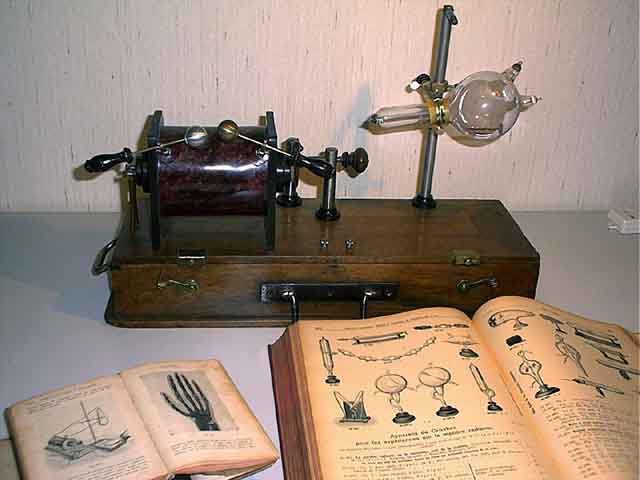
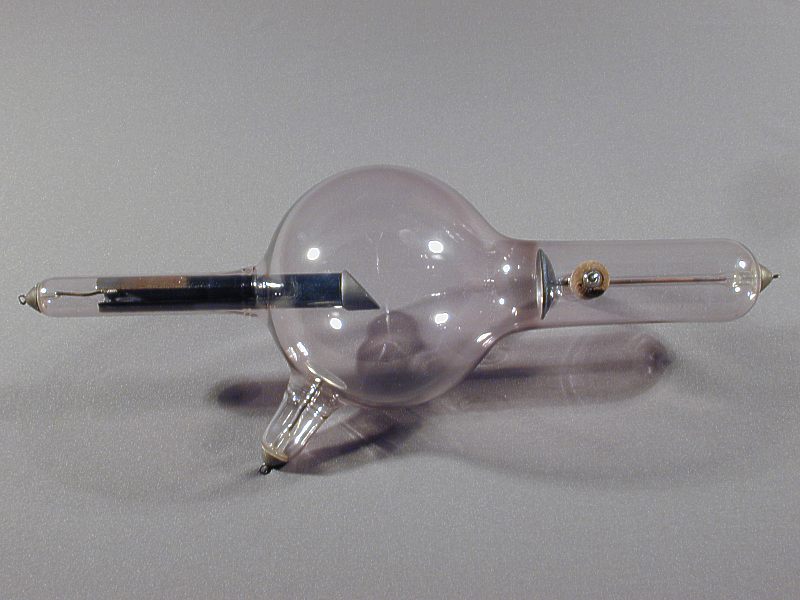
On December 28, 1895, Röntgen issued a publication for the Society of Physics entitled: “A New Type of Radiation.” On 23/01/1996 he announced all the results with a lecture and demonstration at the University in Würzburg.
On 10/12/1901, Wilhelm C.Röntgen received the Nobel Prize in physics. He gave the cash prize associated with it to the University of Giessen so they would use it to fund scientific studies.
It is also noteworthy that he always waived a patent on his discoveries. He said his discoveries were for humanity.
Soon after the discovery of radiation, the evolution of the new medical application took off.
On 22/12/1895 there was the first recording by the hand of Röntgen’s wife. In January of 1896, the first recording was made of a broken arm. Not soon after that still in 1896 came the first report that this new radiation was harmful.
In 1904 the first digestive examination was performed with a contrast medium.
As early as 1908, the amplification screen for films was introduced, and another 5 years later came Bucky-Belbe’s scatter-ray filter (now called Bucky grid). In 1952, the image intensifier was developed which gave the possibility of fluoroscopy.

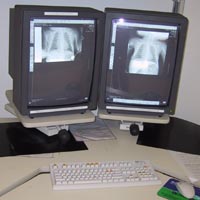
Finally, in 1980 came digital radiology, which will increasingly define the future of radiology in all its applications.
With the advent of digitization, the possibilities of radiology have expanded even more if possible. Think of capabilities such as zooming in on an image, adjusting contrast, adding color, … all features that can provide enhanced interpretation.
Also with digitization came the ability to share images in a fast efficient way, with applicants, as well as with colleagues to seek additional advice. Radiology regained momentum as a result, and the possibilities are increasing…. (cfr. PACS and digitization)