


What is ultrasound?
Ultrasound is an examination technique that works on the principle of sound waves reflected back under the form of echo that is then recorded.
Ultrasound, i.e., a sound frequency above human hearing, is used. We are talking about frequencies above 20 000 Hz. The frequencies used in diagnostic ultrasound is between 1,000,000 and 20,000,000 Hz.
| Infrasound | < 20 Hz | ||
| Audible sound | 20 – 20 000Hz | ||
| Ultrasound | > 20 000 Hz | ||
| Diagnostic ultrasound | 1 000 000 – 20 000 000 Hz |
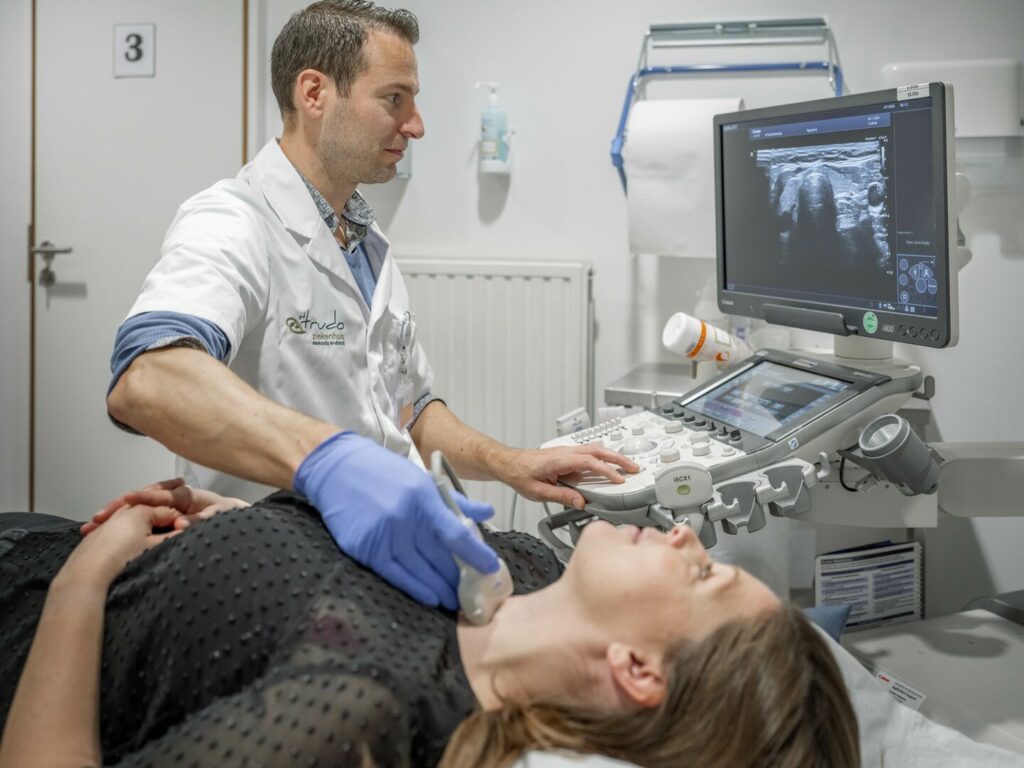
To have an idea about how the image is formed, the speed at which the waves travel through matter is also important.
| Air | 330 m/sec |
| Water | 1540 m/sec |
| Fat | 1450 m/sec |
| Tissue | 1540 m/sec |
| Blood | 1570 m/sec |
| Muscle | 1585 m/sec |
Types of ultrasound imaging
A-mode (amplitude)
The echoes are recaptured by the device and displayed on the screen as spikes. The distance between 2 peaks is the distance between 2 different structures, and the height of the peak is equal to the intensity of the reflected wave.
B-mode (Brightness)
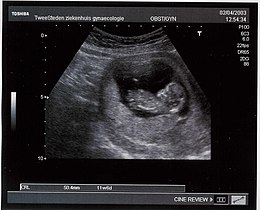
Instead of spikes, one now gets a sequence of points that vary in intensity. The distance between them is still the distance between different structures, but the intensity of the reflected wave determines the color of the dot. The more intense the echo the whiter it appears.
In this way one obtains a 2-Dimensional image. Namely, all points on a line and all lines below each other form an image.
M-Mode (Motion)
This technique is used to write out movement in time, cfr. Doppler.