What are x-rays?
X-rays are electromagnetic waves with very short wavelengths that propagate in all directions. Displacement occurs at the speed of light (i.e., 300,000 km/sec.). They have the property of being able to pass through matter, passing their energy to that matter. As a result of this energy transfer onto matter, there is ionization of matter. Hence, X-rays are also called ionizing radiation.
Radiation spectrum

How are X-rays generated?
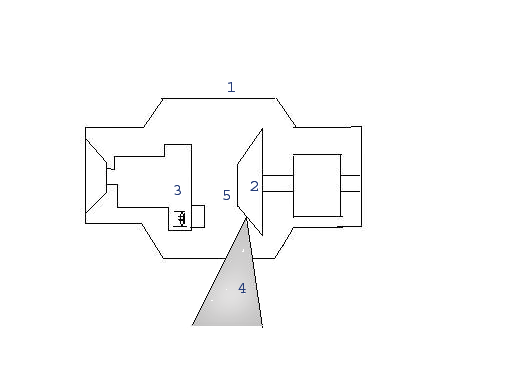
To generate X-rays, we use an X-ray tube. It is composed of a cathode where electrons are generated. A high voltage accelerates these electrons and they “collide” with an anode, which may or may not be rotating. In the process, all or part of the motion energy will be converted into radiant energy. Note, however, that only 1% effective X-rays are developed, the remaining energy is mainly heat.
From the place on the anode where the electrons collide (= focus), radiation is scattered in all directions. Therefore, the X-ray tube has a lead casing with a window in one place only. Thus one obtains a certain direction of radiation that we can direct toward the object to be examined. The advantage of the rotating anode is that the heat is better distributed which extends the life of the X-ray tube.
Schematic of an x-ray tube
- Casing in lead glass
- Turning anode
- Cathode
- By form of Anode focused radiation
- electrons go from the cathode (3) to the anode (2)