


Principle
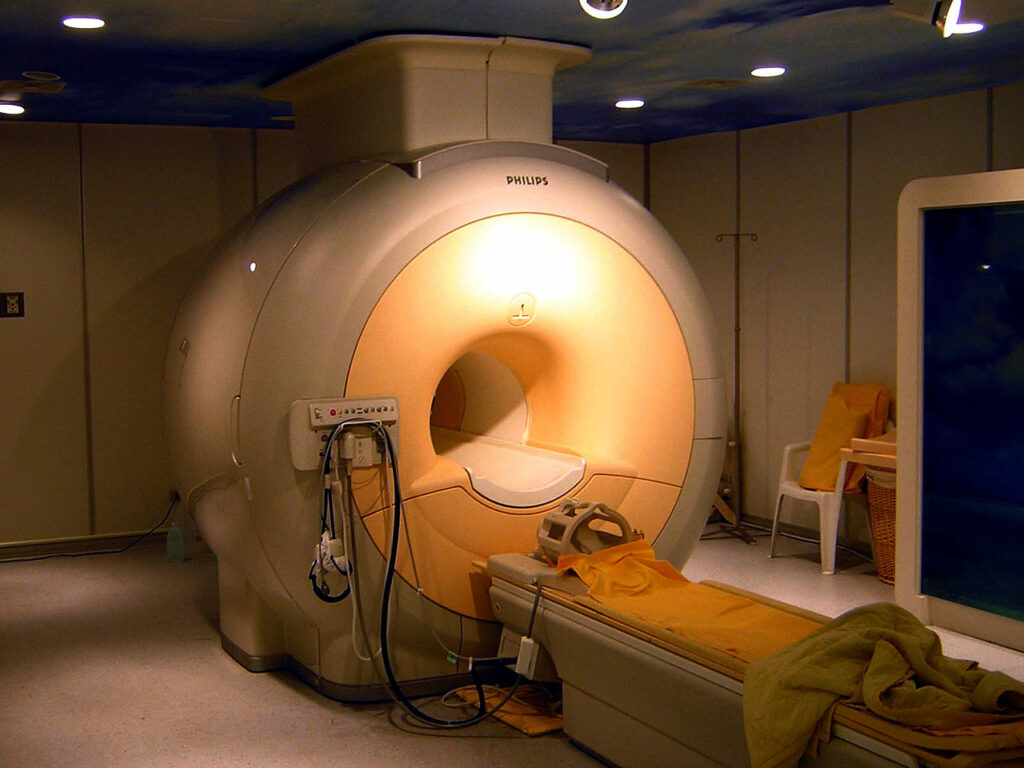
Magnetic Resonance Imagingis obtained by placing the part of the body to be examined in a magnetic field that is switched on and off, creating a “resonance” that depends on the nature of the matter involved.
The human body is composed of several atoms, including hydrogen protons (H+). Each of those protons acts as a kind of magnet with and positive and a negative pole.
Bringing the body into the MRI magnet causes each of those protons, which are directed in all directions when at rest, to rotate in the same direction as the magnet. Thus, a state of equilibrium is achieved. Now by sending a radio wave through the magnetic field, the protons are momentarily taken out of equilibrium, this lasts until the radio wave disappears again, then they return to their resting state. During this return, the protons generate a radio signal that can be received by antennas located close to the patient. By processing this signal generated in frequent succession, the computer can form an image, in the axial direction, as in CT, but also in any other desired plane. The frequency of those signals is tissue dependent. So in this way, one can make a good differentiation between the different structures of the body.
Advantages:
 | The ability to create images in different planes |
| No ionizing radiation is used |
| To date, there have been no reports of allergic reactions to the contrast media used |
Disadvantages:
| Narrow tube easily gives rise to problems with claustrophobia |
| Longer examination times |
| The long recording times make it less functional for examination of moving organs, such as the heart or intestines |
| PROHIBITED in the presence of pace maker or metal clips or prostheses |