


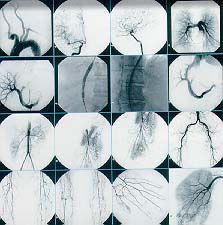
Angiography is an examination of the blood vessels. These can be either arterial or venous blood vessels. To get an image of the blood vessels, a contrast medium is injected that is visible on X-rays. In this way one can obtain and image of the course, shape and permeability of the blood vessels. To make the images appear clearer, one uses subtraction. In this process, the obtained image with contrast fill is subtracted from an image without contrast fill. Thus, one obtains an image on which only the difference between the two images is still visible.
We distinguish two types of studies. Venous and arterial angiography.
Intravenous angiography:
Preparation:
 | the patient should be sober at least since four hours before the examination |
| Results of coagulation tests must be known. |
| Supervised infusion in the left arm, to take care of any problems during the examination, and to ensure adequate fluid administration |
Aftercare:
| Good control of the puncture site to prevent subsequent bleeding |
| No bed rest required unless puncture in groin, in the latter case, at least four hours of bed rest should be provided |
| Infusion may stop when empty, or when patient goes home |
Intra-arterial angiography
Preparation:
| Sober at least four hours before the examination. (This is no longer a requirement, but is still requested) |
| No contrast should be present from previous examinations |
| The patient is taken to the radiology service with the bed |
| Putting on a surgical shirt |
| Vigil infusion provided, preferably in the left arm |
| results of blood clotting tests must be known |
Aftercare:
| Monitor blood pressure for twelve hours |
| Good and regular monitoring of the puncture site to prevent any subsequent bleeding |
| 24h mandatory bed rest (may reduce to 12 hours provided puncture with a thin needle and catheter) |
| Fluid balance tracking, high contrast volumes can lead to renal insufficiency |
| Ensure adequate fluid intake, maintain IV if necessary |
Angioplasty
Angioplasty is the collective term for all the interventions that can be done at the level of blood vessels using an intravenous or intra-arterial puncture. Thus, work is done from one or sometimes two puncture sites directly into the blood vessels.
The options we have in this regard are: blood vessel dilation, blood vessel stenting, embolization, …
Back up