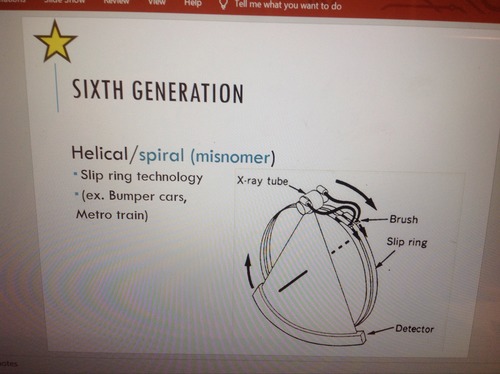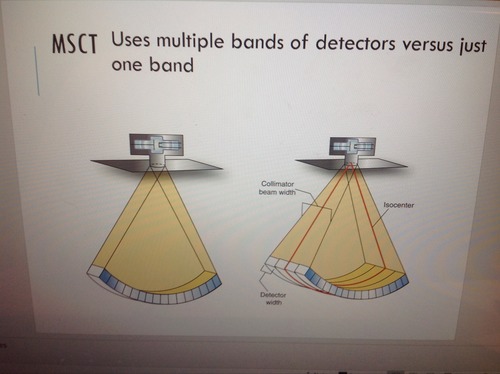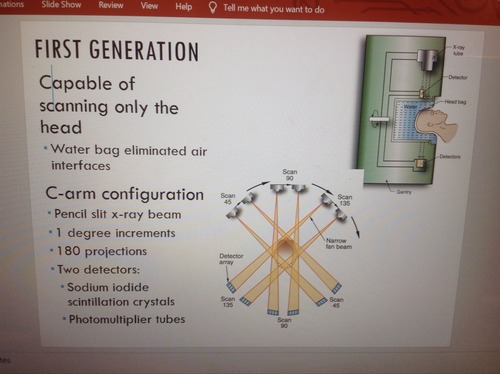
In 1967, there was already the first clinical application by Sir Houndsfield. In 1971, the first brain scan was made and in 1974, the first full-body scan recording was made. The development of the scan went through several phases that were mostly technically related. As technology evolves, the scanners become more performant and the images sharper and more functional. Also, the evolution of the computer and the ever faster processors make the scanner a permanently growing system, to which CT 1st generation many new and better techniques can be applied. Consider here, for example, the creation of 3D reconstructions.
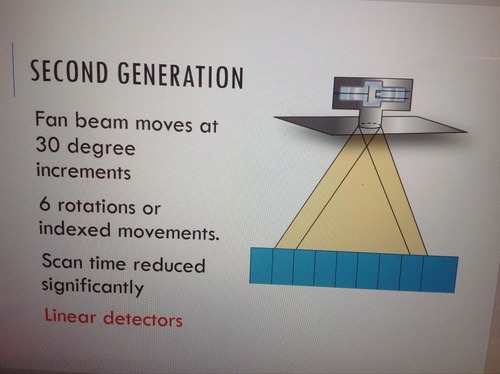
CT scan 2nd generation
The second-generation CT scan was based on the same principle, but used different tubes and detectors that rotate a number of degrees after taking an image.
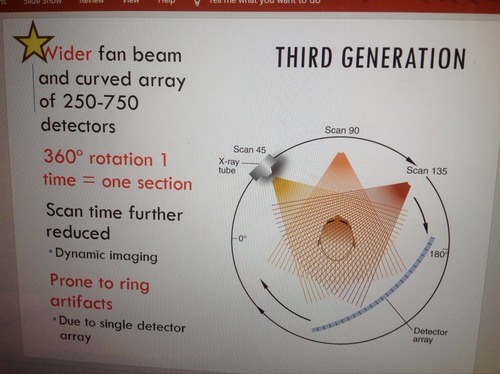
Third-generation CT scan
By the third generation, they left back from the first generation. A tube was used again, but the receptor would rotate with the tube. In this way, one could make a continuous rotation of the tube for one complete image.
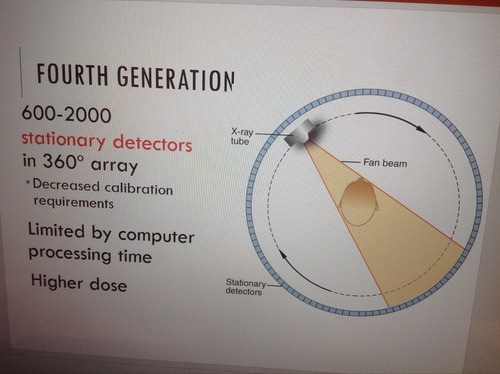
Fourth-generation CT scan
A fourth generation was never really used, the principle of which was to use a rotating tube with a stationary detector extending over the entire circumference of the gantry.